


Instagram Reels vs YouTube Editing: What’s Different, and Why It Matters
A common assumption among businesses and creators just starting to invest in video content is that Reels vs YouTube editing follows the same process—that the same skill set and approach applies whether you’re posting a 30-second Reel or a 15-minute YouTube video. In reality, Reels vs YouTube editing involves different editing disciplines, with unique pacing, structure, and creative priorities. Understanding Reels vs YouTube editing helps you brief an editor more effectively and evaluate whether a portfolio of Reels truly demonstrates the ability to edit long-form YouTube content well, or vice versa.
Pacing: Fast Cuts vs. Sustained Attention
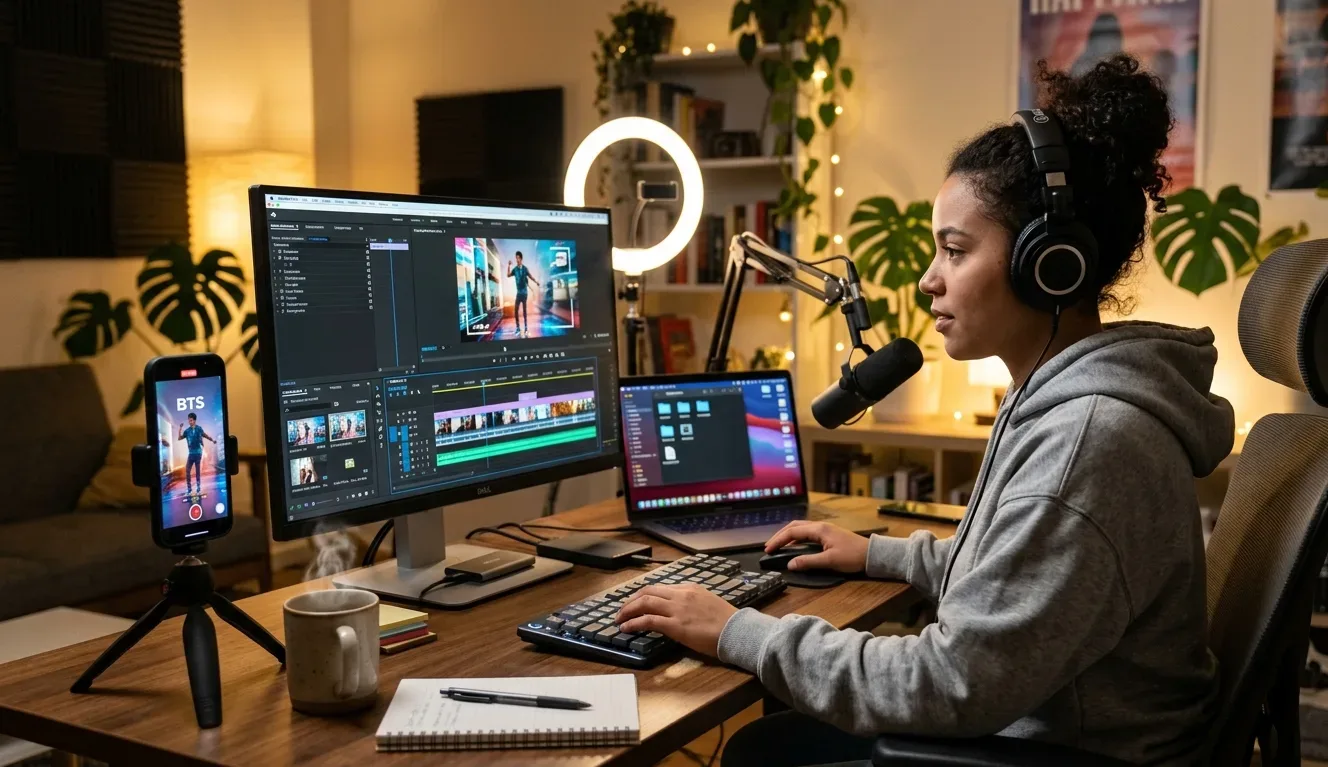
Reels vs YouTube editing differs significantly in both style and strategy. Reels are built around holding attention in the first 1-2 seconds and maintaining rapid visual change throughout — cuts every second or two, constant motion, text appearing and disappearing quickly. YouTube long-form content, by contrast, needs to sustain a viewer’s attention over minutes, which means pacing that breathes — letting a moment land, using b-roll to support a point rather than constantly cutting away from it, and structuring content in a way that rewards continued watching rather than just the first few seconds.
Structure: Loop-Friendly vs. Narrative Arc
Reels vs YouTube editing also differs in the way each format is structured. A well-edited Reel is often designed to loop seamlessly — the ending flows back into the beginning, encouraging a rewatch that boosts the algorithm’s engagement signals. A YouTube video is structured more like a traditional narrative: a hook, a clear middle section building toward a point or payoff, and a resolution or call-to-action at the end. An editor used to only cutting Reels can genuinely struggle to structure a 10-minute video that keeps viewers watching through to the end, since it’s a different storytelling skill, not just a longer version of the same task.
Text and Captions: Different Roles Entirely
On Reels, captions are often central to the content itself — many viewers watch with sound off, so on-screen text carries much of the meaning, timed precisely to match speech and emphasis. On YouTube, captions are more commonly a secondary accessibility layer, with the visual and verbal content designed to work without relying on text at all. An editor who over-uses YouTube-style subtle captions on a Reel, or under-uses Reels-style bold captions on a YouTube video, is applying the wrong tool for the platform.
Sound Design Priorities
Reels vs YouTube editing also involves different approaches to audio. Reels lean heavily on trending audio and precise music synchronisation — a cut landing exactly on a beat drop is often what makes a Reel feel satisfying and shareable. YouTube content leans more on clear spoken audio, consistent levels across a longer runtime, and subtler background music that supports rather than dominates. Podcast video editor sits somewhere adjacent to both, prioritising clean, consistent speaker audio above all else, since that’s what podcast audiences are most sensitive to.
Thumbnail and Cover Frame Thinking
YouTube editing typically includes selecting or informing a custom thumbnail design, since thumbnails are a major driver of click-through on that platform. Reels have no equivalent step — the cover frame matters far less than the first second of actual motion and sound once someone’s already scrolling through their feed.
What This Means When You’re Hiring an Editor
If your business needs both Reels and YouTube content, it’s worth asking directly to see examples of both from any editor or agency you’re considering — a strong Reels portfolio doesn’t guarantee strong long-form editing ability, and the reverse is equally true. Some editors specialise in one format; others, like our team, work across both because we treat them as genuinely different skillsets rather than assuming one style transfers automatically to the other.
How This Affects Content Strategy, Not Just Editing
Understanding this distinction also changes how you should brief your content in the first place. Footage shot with only long-form YouTube use in mind often doesn’t translate well into a punchy Reel without additional b-roll or reframing, and footage shot purely for quick Reels sometimes lacks the sustained, connected moments a YouTube edit needs to build a narrative. Planning your shoot with both formats in mind from the start — capturing some longer, uninterrupted moments alongside quick, punchy ones — gives your editor more to work with across both platforms from a single shoot.
Video Editing Packages & Pricing
| Package | Includes | Price |
| Reels / Short-Form Edit | Up to 60 sec, trending transitions, captions, music sync | Rs 499 – Rs 1,499 per video |
| YouTube Long-Form Edit | Full episode/vlog edit, colour correction, sound design | Rs 1,999 – Rs 5,999 per video |
| Podcast Video Package | Multi-cam switching, audio leveling, subtitles, clip cutdowns | Rs 3,999 – Rs 8,999 per episode |
| Monthly Retainer | Set number of videos/month across formats, priority turnaround | Custom Quote |
Frequently Asked Questions
Is Reels editing different from YouTube video editing?
Yes, Reels editing prioritises fast pacing, loop-friendly structure, and bold on-screen captions, while YouTube editing focuses on sustained narrative structure, subtler captions, and thumbnail selection.
Can the same editor handle both Reels and YouTube editing well?
Some editors specialise in one format, while others work across both by treating them as genuinely different editing disciplines — it’s worth reviewing portfolio examples of both formats before hiring.
Does podcast video editing need a different approach than Reels or YouTube?
Yes, podcast video editor prioritises clean, consistent speaker audio above all else, along with multi-camera switching and short clip cutdowns for social promotion.
Should I shoot footage differently depending on whether it’s for Reels or YouTube?
It helps to capture a mix of quick, punchy moments and longer, uninterrupted footage during the same shoot, so your editor has enough material to cut both a strong Reel and a well-structured YouTube video from it.
Why do captions matter differently on Reels versus YouTube?
Many Reels viewers watch with sound off, making bold, precisely timed captions central to understanding the content, while YouTube captions are more commonly a secondary accessibility feature.
Need an editor who treats Reels and YouTube as the different skills they are? Contact Ricky Tech at +91 9971572965 or info@rickytech.co.in.


